
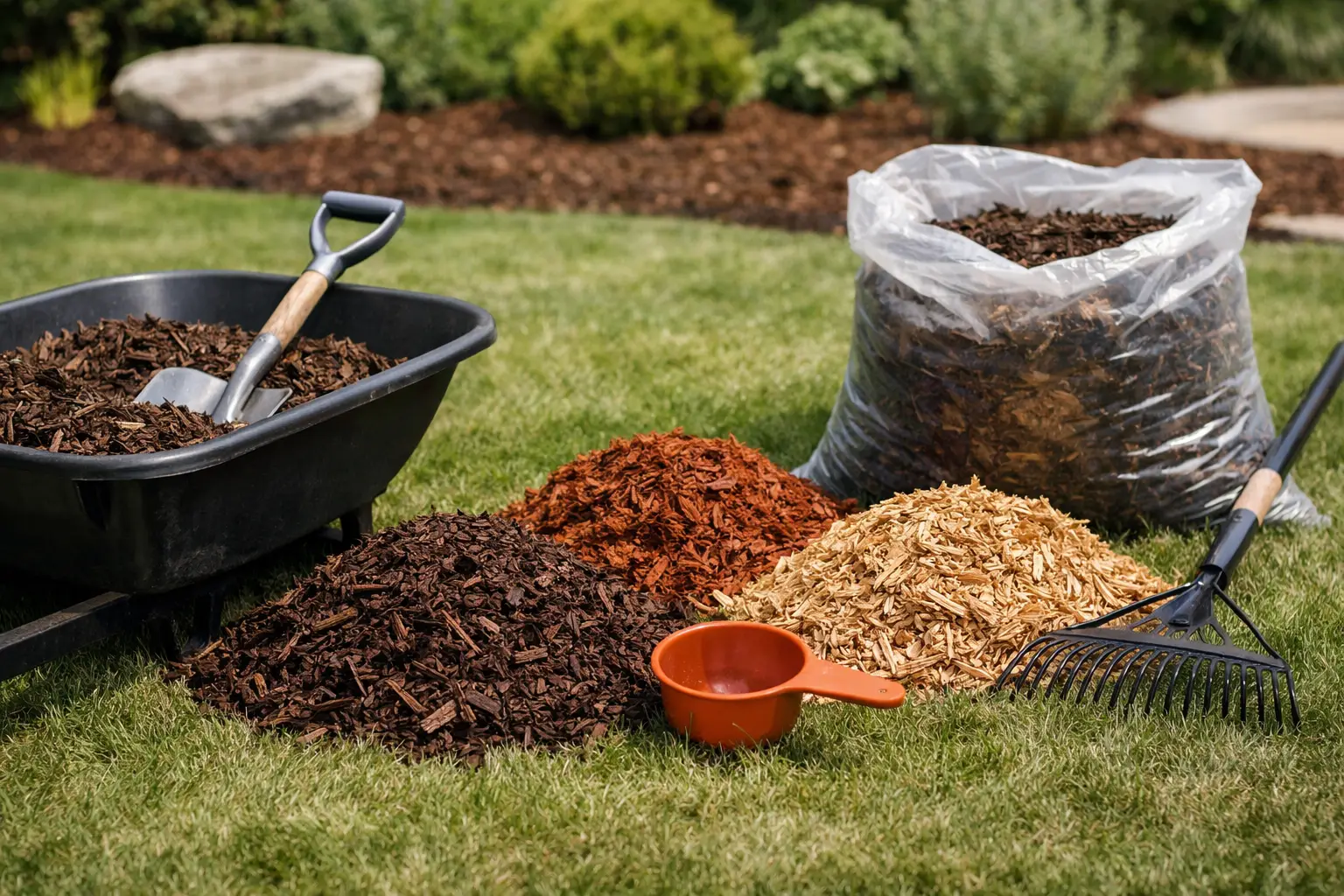
If you’re standing in the driveway staring at a pile of empty beds and asking, how much mulch do I need, you’re already asking the right question. Too little mulch looks unfinished and does not do much for moisture control. Too much can smother roots, hold excess moisture, and make a clean landscape look bulky instead of polished.
The good news is that mulch is one of the easier landscape materials to estimate once you know two things: your square footage and your target depth. Whether you’re freshening up front foundation beds, finishing a tree ring, or cleaning up the backyard before the season gets busy, a quick calculation can save time, money, and a second trip.
How much mulch do I need? Start with area and depth
Mulch is usually measured in cubic feet or cubic yards. Bags are commonly sold by the cubic foot, while bulk mulch is typically sold by the cubic yard. One cubic yard equals 27 cubic feet, and that number matters because it is the basis for almost every mulch estimate.
Start by measuring the length and width of each bed in feet. Multiply those numbers to get square footage. If the area is not a perfect rectangle, break it into smaller shapes, estimate each section, and add them together. That gets you close enough for most home landscape projects.
Next, decide how deep you want the mulch. In most planting beds, 2 to 3 inches is the sweet spot. Two inches works well for a light refresh over existing mulch. Three inches is better for bare soil, weed suppression, and a more finished look. Going beyond that is usually not helpful unless you are dealing with a very specific site condition.
Here is the practical formula:
Square footage x desired depth in inches / 324 = cubic yards of mulch needed.
So if your bed is 324 square feet and you want 3 inches of mulch, you need 3 cubic yards. If your bed is 162 square feet and you want 2 inches, you need 1 cubic yard.
That formula sounds more complicated than it is. Once you use it once or twice, it becomes second nature.
A quick mulch coverage guide
If math is not what you came here for, use these rough coverage numbers instead. One cubic yard of mulch covers about 162 square feet at 2 inches deep. It covers about 108 square feet at 3 inches deep. It covers about 81 square feet at 4 inches deep, though 4 inches is more than most planting beds need.
For bagged mulch, a standard 2-cubic-foot bag covers about 12 square feet at 2 inches deep, or about 8 square feet at 3 inches deep. That means 13.5 bags equal roughly one cubic yard.
Those estimates are useful when you’re deciding between a few bags for touch-up work and a bulk delivery for a larger property. If you’re mulching several beds, bulk often makes more sense. If you’re just dressing up a few containers, tree rings, or a narrow side yard, bags can be more convenient.
Best mulch depth for different parts of the yard
Not every area should be mulched the same way. Depth depends on what you are covering and what you are trying to accomplish.
For flower beds and shrub borders, 2 to 3 inches is usually ideal. That is enough to help retain moisture, reduce weeds, and create that neat, dark backdrop that makes plants stand out.
Around trees, keep mulch about 2 to 3 inches deep, but never pile it against the trunk. A mulch volcano might seem tidy at first glance, but it can trap moisture against the bark and create long-term problems. Keep the mulch pulled back a few inches so the trunk can breathe.
For vegetable gardens, go lighter and be selective. Some gardeners mulch pathways more heavily while keeping mulch thinner around stems and crowns. Moisture retention is helpful, but too much mulch close to edible crops can hold too much dampness in certain spots.
Play areas and pathways are different. These spaces may use deeper material for cushioning or coverage, but that is more of a specialty application than standard landscape mulching.
Common measuring mistakes that throw off your order
The biggest mistake is estimating by eye. A bed always looks smaller from the patio than it does with a tape measure in your hand. Curved edges, corner beds, and island plantings can add up fast.
Another common issue is forgetting the difference between a refresh and a first-time application. If a bed already has 1 inch of mulch left from last season and you want a finished 3-inch layer, you are only adding 2 inches, not starting from zero. That can change your order quite a bit.
People also tend to overdo depth. Four or 5 inches may sound like better weed protection, but in most ornamental beds it is simply too much. Mulch should help the landscape, not bury it.
Then there is settling. Fresh mulch can look fluffy right after installation and compact a bit over time. That does not mean you should automatically over-order by a full yard. A little extra is smart. Ordering far beyond what you need usually turns into a pile you have to figure out later.
How to estimate odd-shaped beds without overthinking it
Long Island yards are full of curved foundations, front walk beds, backyard borders, and tree islands that do not fit a perfect rectangle. The easiest approach is to break the area into simple sections.
Measure a curved bed as if it were a rectangle, then subtract a little if needed. Or divide it into two or three rough zones, calculate each one, and combine them. You are aiming for a practical estimate, not an engineering drawing.
For circular tree rings, measure the diameter across the circle. Divide that number by two to get the radius. Then multiply radius x radius x 3.14 to get square footage. Once you have that number, use the same mulch formula.
If you are covering multiple separate beds, calculate each area one at a time instead of trying to guess the whole property at once. It takes a few extra minutes, but it is much more accurate.
Bags or bulk mulch?
This depends on project size, storage space, and how fast you want to get the job done. Bagged mulch is easy to transport in smaller amounts and simple to stage exactly where you need it. It works well for quick weekend touch-ups, small beds, and homeowners who prefer a clean, manageable setup.
Bulk mulch makes more sense for larger refreshes, newly installed landscape beds, and properties with several planting areas. It can be more efficient, especially when you are doing the front yard, side beds, and backyard all at once. The trade-off is that you need a place for delivery and a plan to move it efficiently.
If your project sits somewhere in the middle, it often comes down to convenience. Ten or twelve bags can be easy. Thirty or forty bags starts to feel like a different kind of project.
How much extra mulch should you order?
A little cushion is smart, especially if your bed lines are irregular or your measurements are rough. For most jobs, adding about 5 to 10 percent is enough. That covers settling, slight measuring errors, and the fact that not all beds are perfectly flat.
If you are right on the edge between two quantities, it is usually better to round up modestly rather than come up short with a half-finished bed. Just do not confuse a sensible buffer with doubling your estimate.
Mulch appearance matters too
Coverage is not the only goal. The right amount of mulch changes how the whole yard reads from the street. Freshly mulched beds frame annual color, make foundation shrubs look sharper, and give trees and hedges a cleaner finished base. That is why depth matters so much. Too thin looks patchy. Too thick looks heavy.
For homeowners focused on curb appeal, a consistent layer across all visible beds usually delivers the best result. You want the landscape to look intentional, not like some sections were guessed at and others were overfilled.
If you are planning a seasonal refresh and want help choosing the right quantity, material, or application for your property, Westminster Nursery can help you get your beds looking clean, current, and ready for the season. A well-mulched yard does more than tidy things up. It gives every planting around it a better place to shine.