
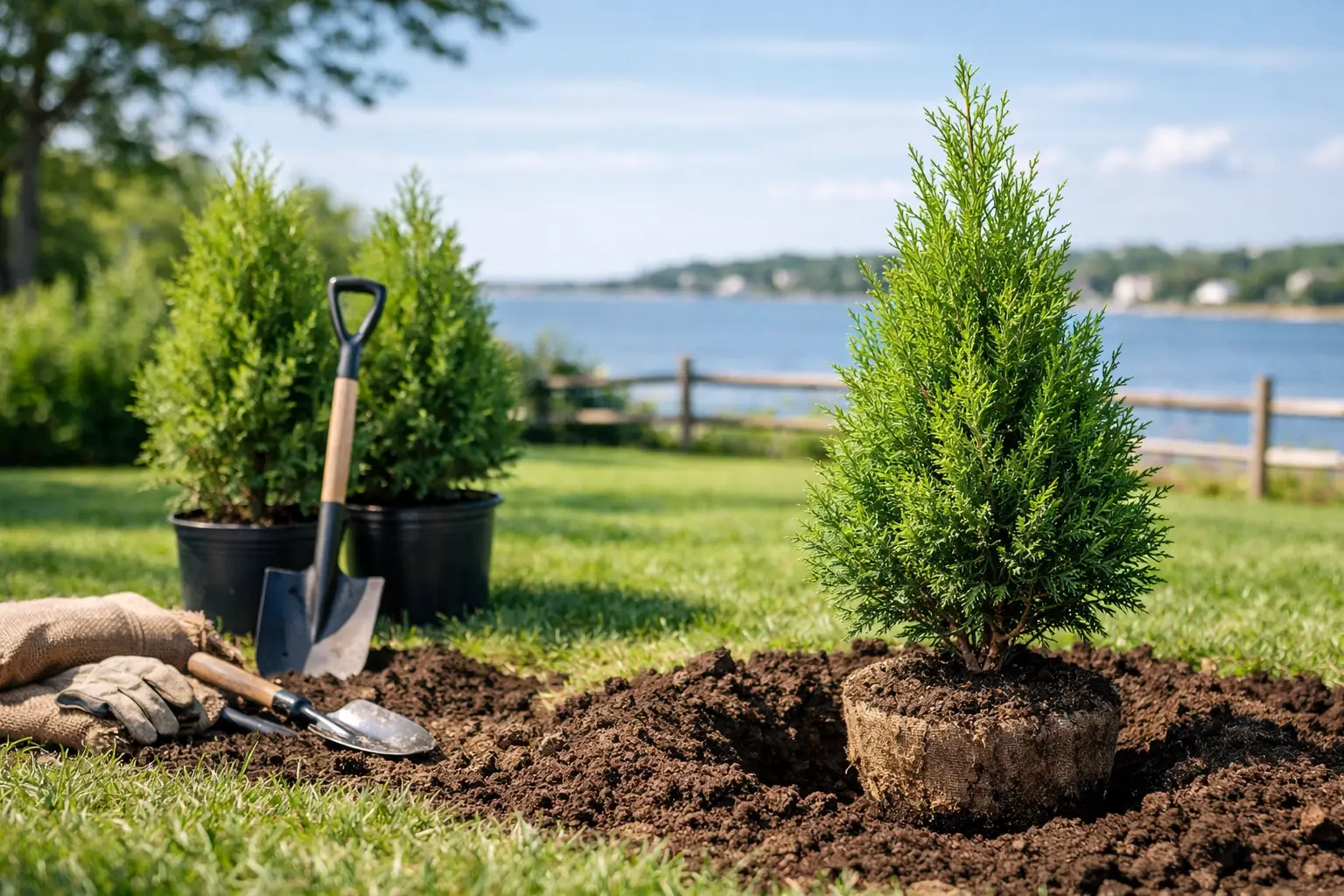
If you are planning a privacy hedge this season, timing matters more than most people think. Knowing when to plant arborvitae can mean the difference between a hedge that settles in fast and one that spends its first year struggling through heat, drought, or winter stress.
On Long Island, arborvitae is a go-to choice for homeowners who want fast screening, clean evergreen color, and a more finished look around the yard. It works well along property lines, around pools, near patios, and anywhere you want year-round coverage. But even a strong, dependable plant like arborvitae performs better when it goes into the ground at the right time.
When to plant arborvitae for best results
For Nassau County and the broader Long Island area, the best time to plant arborvitae is generally early spring or early fall. Those two windows give the roots time to establish while temperatures are milder and moisture is usually more reliable.
Spring planting works well because the soil is warming up and the plant has a full growing season ahead. If you plant in spring, aim for the period after the ground has thawed but before summer heat arrives. That gives arborvitae time to settle in before it has to handle July and August stress.
Fall is often even better for many evergreen installations. The air is cooler, the soil is still warm from summer, and the plant can focus on root development instead of pushing lots of top growth. On Long Island, early fall planting usually offers a very comfortable transition for arborvitae, as long as you give it enough time before the ground starts to freeze.
The one season that tends to create the most problems is the peak of summer. Arborvitae can be planted in summer, especially if it is container-grown and properly watered, but the margin for error is smaller. Hot sun, dry soil, and windy conditions can quickly stress new plants.
Why timing matters with arborvitae
Arborvitae is popular because it fills in nicely, stays evergreen, and creates strong privacy without a complicated care routine. Even so, newly planted arborvitae has one main job at first – building roots.
When the roots are trying to establish during extreme heat, the plant has to work harder to keep moisture in its foliage. That is why summer planting often leads to browning tips, uneven growth, or slower recovery after transplanting. When planting happens in spring or fall, conditions are usually gentler, which helps the root system expand before the harshest weather arrives.
This is especially relevant in our area. Long Island properties can have sandy soil, windy exposure, reflected heat from driveways, and tight side-yard spaces where moisture levels swing quickly. Good timing gives your hedge a stronger start in exactly those real-world conditions.
Spring vs. fall planting
If you are deciding between the two main planting seasons, the better choice depends on your schedule, your site, and how prepared you are to water.
Spring planting advantages
Spring is a strong option if you want to enjoy the new hedge right away and have time to monitor it through the growing season. Plants installed in spring can start rooting in as temperatures rise, and you can watch for any issues before winter.
The trade-off is that spring-planted arborvitae heads into summer not long after installation. If there is a dry stretch, watering becomes critical. Miss a few hot weeks, and young plants can show stress quickly.
Fall planting advantages
Fall planting is often ideal for evergreen privacy material because root growth can continue while top growth slows down. The plant directs energy below ground, which is exactly what you want early on.
The trade-off here is timing. Plant too late in the season, and roots may not establish enough before cold weather. Early fall is much better than late fall for that reason.
When to plant arborvitae in Nassau County and Long Island
Local weather always matters more than the calendar alone. A mild spring can open the planting window earlier, while a hot, dry September may call for extra watering even in a season that is usually easier.
As a general rule, Long Island homeowners should look at two practical windows. The first is from early spring into late spring, once the soil is workable. The second is from early fall into mid-fall, while the soil is still warm and before real winter conditions set in.
If you are planting a privacy row of Green Giants or other arborvitae varieties near a property line, it is smart to think beyond planting day. Look at sprinkler coverage, drainage, sun exposure, and how close the hedge sits to fences or pavement. A perfect planting date will not compensate for a site that dries out every afternoon or stays soggy after rain.
Signs it is a good time to plant
Homeowners often ask for an exact week, but the better approach is to read the conditions. Arborvitae is ready to plant when the ground is workable, daytime temperatures are moderate, and you can commit to regular watering during the first establishment period.
If the soil is still frozen, planting is too early. If a heat wave is settling in and the planting area gets full afternoon sun, waiting is usually the better move. If early fall arrives with cooler nights and steady moisture, that is often a green light.
This is one of those cases where a local garden center can save you a lot of guesswork. The right timing for planting in West Hempstead may look slightly different from a more exposed coastal spot or a shaded inland yard.
What happens if you plant at the wrong time
Arborvitae planted too late in summer or too close to winter often spends its first season in survival mode. That does not mean it will fail, but it usually means slower rooting, more watering, and a greater chance of browning or thinning.
Planting at the wrong time also tends to amplify smaller issues. If spacing is a little tight, if the soil drains poorly, or if deer pressure is present, a stressed new planting will show those problems faster than one installed in a better season.
For privacy hedges, that matters because consistency is the whole look. One weak tree in a row can interrupt the screen and make the entire planting look uneven.
A few planting details that matter just as much as timing
Once you know when to plant arborvitae, the next step is giving it the right setup. Planting depth is a big one. Arborvitae should sit at the proper grade, not buried too deeply. Soil should be firm but not compacted, and watering should be deep enough to reach the root ball.
Spacing matters too. Homeowners sometimes plant too close because they want instant privacy, but overcrowding can create long-term issues with airflow and mature width. The better move is to match spacing to the specific variety and your privacy goal.
Mulch helps retain moisture and regulate soil temperature, especially in the first year. Keep it around the root zone, but do not pile it against the trunk. That simple step goes a long way during both summer heat and winter swings.
Choosing the right arborvitae for the space
Not every arborvitae fits every yard. Some homeowners want a tall, fast-growing screen. Others need a narrower profile for a side yard or a foundation bed. The right variety affects spacing, maintenance, and how quickly you get the look you want.
That is why shopping locally helps. At Westminster Nursery, many customers come in asking for privacy, but what they actually need depends on the width of the planting area, the amount of sun, and how formal or natural they want the hedge to feel. Green Giants are popular for speed and height, but other arborvitae types can be a better fit for tighter spaces.
After planting, the first season is the real test
The planting date gets arborvitae off to a good start, but aftercare is what carries it through. New arborvitae needs consistent watering, especially during dry stretches. That does not mean soggy soil. It means steady moisture while roots establish.
Watch the foliage during the first few months. Some minor adjustment stress is normal, but widespread browning, drooping, or drying out usually points to a watering or site issue that needs attention. Catching that early is much easier than trying to correct a declining hedge later.
If your goal is a full, healthy privacy screen, patience matters. Arborvitae can grow quickly, but the strongest long-term results come from good timing, correct spacing, and steady care in year one.
For most Long Island homes, the safest answer is simple: plant arborvitae in spring or early fall, avoid the toughest heat when possible, and match the variety to the space. Get that combination right, and your hedge has a much better chance to fill in strong, stay green, and give your yard the privacy and polished look you wanted in the first place. If you are not sure which window makes sense for your property, a quick local conversation before planting can save an entire season of second-guessing.